Issues that hinder the Oroko People at Home and Abroad.

Issues that hinder the Oroko People at Home and Abroad.

A Presentation on the Occasion of the 2014 Oroko Convention in Atlanta, GA. USA (30th August 2014) – By Mukete Daniel Modika


Mr. President of OCA USA

Your Royal Highnesses;
Distinguished Invitees;
Dear Brothers and Sisters.

I. Plan of Presentation
Formalities: Permit me to first of all express my joy of being here today accompanied by my dear wife Josephine. Our presence here was neither planned nor dreamed of. But we are here by the Grace of God and the machinations of the Cameroon government that decided to send me to Washington to open a Tourism Information Bureau for Cameroon. This bureau covers the continents of North and South America. We are happy to be here with my children.

That said, let me thank the President of OCA, Tata Fred Mboe Mediko for giving me the opportunity to stand before you to talk about issues that hinder the progress of Bato ba Oroko. I can guess why he chose me for this task. It is because I have lived among and interacted with the Oroko people for over half a century. This however, does not make me an expert in Oroko affairs. I would have loved to talk about the beauty of the Oroko women. This would have been easier for me because I was born by one, and I have been living with one for the past 32 yrs and that union has produced some very beautiful Oroko ones.

I thank God for the very warm welcome my wife and I have received from many of you. I lack words to express myself but I pray God to bless you abundantly.

II. What is said about the Oroko Problem?

Distinguished Guests, Ladies and Gentlemen,

The people who call themselves Oroko are made up of ten tribes: Bakoko, Bakundu, Balondo Badiko, Balondo Banaga, Balue, Batanga, Bima, Ekombe, Mbonge and Ngolo tribes. They are found in two administrative divisions of the South West Region of Cameroon – Meme and Ndian Divisions and together have built 205 villages.

From these statistics we cannot deny the fact that the Oroko people constitute a major grouping in the South West Region of Cameroon, and it follows therefore that we are expected to make a reasonable contribution or create a great impact in all domains of our national life. In other words we are expected to make a reasonable contribution in the economic, cultural, social and political development process of our beloved country Cameroon. In the same vein, we are entitled to a corresponding; an appropriate or befitting share of the national cake.

The issue here is how much is our contribution and how much is our share of the national cake? The answers to these questions calls for the drawing-up of a statement of account of Oroko people both in the national and international context.

When this is done, we will then be able to make a concrete statement about our pace or state of development. Whether we are progressing at an acceptable pace or we are stagnating or regressing. This is a monumental task requiring a scientific study based on the analysis of available facts and figures. It can be done and it should be done.

Writings about the various Oroko tribes can be found in German and English archives and are growing steadily in the archives of the various Universities in Cameroon. This is as a result of the increasing number of Oroko students graduating with post graduate degrees from these universities. Unfortunately literature concerning the performance of Oroko people as a group is very scarce.

However, the few who have addressed this issue are of the opinion that the Oroko people are hospitable, honest, trustworthy and peace-loving. They say that the people are blessed with geographic and climatic conditions which give them enormous economic potential. Hence, the area they occupy is famous for the cultivation of cash crops like cocoa, rubber, coffee, palm trees just to mention but a few. They also can produce all kinds of food crops. Even their sub-soil is full of minerals. And they conclude by saying that in terms of natural resources, their inheritance (or contribution) is outstanding, if not monumental. These are very strong points in favour of the Oroko people. Compared with their achievements, one of the writers, an economist and the most knowledgeable in the Oroko way of life, Mr. Mosamai Emanuel Dibo, in his pamphlet “BO CHANI’SE” says that:

“From the evidence before us it is no secret to conclude that our people have contributed far below their potentials in terms of human resources and in the scramble for national merits and honours. In fact in the recognition and awards table, they do not feature prominently, be it in the domain of academics, finances and economy, culture, sports and politics. This is the irony. A people on whom nature has showered all her material goodness turns out to be handicapped in the race for achievements. The truth is that many of our people are not aware of their predicament and are therefore not in a suitable position to assess themselves in the race of honours vis-à-vis either other groups or their potentials. In actual fact and if we are obliged to give a statement of account of our achievement vis-a-vis our resources, it will be a deficit balance.”

He continues:

“For a simple and for a clearer illustration of our situation, permit me to ask a few questions:

  • How many millionaires have we?
  • How many eminent farmers have we?
  • How many civil administrators have we?
  • How any PhD holders and Professors have we?
  • How many senior army officers and policemen have we?
  • How many medical Doctors have we?
  • How many engineers do we have?
  • How many musicians have we?
  • How many distinguished sports men have we?
  • How many practicing lawyers have we?
  • How many car owners have we?
  • How many city land lords have we?
  • How many first class or second class chiefs have we?
  • How many real politicians have we?
  • How many of us are even there or what is our population vis-à-vis our natural resources?

These questions apply to all of us at home and abroad.

This list of questions sounds elitist. Let us add the following:

  • How many native carpenters have we in our villages?
  • How many native tailors have we in our villages?
  • How many native builders have we?
  • How many native Petty traders have we?
  • How many truck pushers have we?
  • How many tire repairers have we?
  • How many black smiths have we?
  •  How many! How many! How many?
  • ETC, etc.

The common answer to these questions is that we have a number, in each case, which is far from enough”.

My dear brothers and sisters, when I received the letter inviting me to talk on this issue I was so frightened that my first instinct was to turn dawn the request. But then when I thought of this fact that many of us here are not conscious of our perplexing situation I changed my mind although I knew that I could not provide answers or solutions to the problem raised. I accepted because I thought it was time to formally state the problem in a forum like this one – living Oroko organization. And provoke the minds of the elites in the American Diaspora to start reflecting on what to do about the issue of our collective development or advancement.

III. Why and how do we find ourselves in this situation?

Many of us have attributed the situation to internal and external causes:

  1. We are ignorant of our situation.
  2. We are not many enough to take advantage of what nature has given us.
  3. We do not take education very seriously.
  4. We give too much importance to ceremonies (funerals).
  5. We are too timid in our undertakings .
  6. We are not proud of ourselves and our tribe .
  7. We are nonchalant and lazy .
  8. We are not ambitious (how do we perceive life) .
  9. We are not united .
  10. We are not well organized culturally, we are too loose .
  11. We do not have good leadership and our people cannot be led etc, etc .
  12. We have been invaded by strangers .
  13. We are too generous to strangers

My dear brothers and sisters,

We can add many other reasons, but we will need another time to enter into the details of each of these issues.

What have we been doing all this time to solve these problems and how far are we succeeding?

One thing is certain our forefathers were conscious of their situation and even conscious of the fact that some of these problems where beyond the efforts or scope of the individual, family or village to solve. So they initiated a number of collective solutions to some of them:

  • In the field of education, the village came together and sponsored bright children to school.
  • In the economic domain some elite came out with thrift and loan schemes.
  • In the cultural and development domain cultural associations were born at different levels.

How far did these measures go? This is another domain of study.

With regards to the Oroko Cultural Association, Mr. Mosamai said this: “… our forefathers, conscious of the challenges that they faced with regards to the march towards civilization and development, the Oroko Cultural Association was created. This was in respect of the universal dictum that ‘united we stand and divided we fall.’ They believed that there must be unity of purpose and unity in action to effectively face collective challenges. The big idea was that if we organized ourselves into a larger integrated whole, we will create some of the most important conditions for securing a more solid control over our resources, for raising our capacity to produce what we need and consequently, for raising the living standards of our people.”

This assumption is even more relevant today as life has become more challenging and complex.
Distinguished guests, ladies and gentlemen,

I cannot for sure give you the exact date that the Oroko cultural association was formed but what I am certain about is that in 1972 an Oroko cultural Almanac was published with the picture of Late Chief Hon. Chief Victor Ngomo Obie prominently placed with the title of TATA of OROKO printed below. This simply implies that an Organization of Oroko people had been created with Chief V.N. Obie at the head, sometime before the publication of the Almanac. We need to know how the association fared from 1972 to 1995 when it changed from an Association to a Union. This is a good area of research for a PhD Thesis.

This association is today called The Oroko Cultural and Development Union (UDECU-June 1995 at BIG BEKONDO again at the behest of Tata Nganga Obie III).

The June 11th 1995 National Executive Council stood as follows:

  1. National President.  – Tata Okia, HRH Chief Henry Namata Elangwe (Late)
  2. General Secretary     – Chief Esoh Itoh  ( Late)
  3. General Treasurer    – Tata, HRH Chief John Bake Mokambe (Late)
  4. Financial Secretary.   – Tata Nganga, HRH Chief Victor Obie (Late)
  5. Organising Secretary   – Mr. Ngembane Manasseh (Late)

42 years have gone and one is tempted to ask questions as to what the situation of the Oroko people has become and what the state of the Union is.

As of February 5th 2014 when I left Cameroon for the US, one can be tempted to say that UDECU has effective existence only outside of the Oroko land. Where is exists in Meme and Ndian it is in isolated cases and even in those cases it functions occasionally in cases of deaths and some other ceremonies.

UDECU has no cells and no branches. It presently has not met even at the executive level since 1998 for there is no body to convene it. Among the older generation of Oroko people who created it only Chief Esoh Itoh and Justice Benjamin Itoe one of the Advisers and the man who supervised the writing of the constitution and Chief can do something.

My dear brothers and sisters as we can see the Oroko Cultural Association exists and functions only in the United States of America. You have to think of ways to cause the home or mother organization to be better organized and functional otherwise your efforts here to help our people back home will be in vain. Already you see what happens with projects you initiate and containers you send back home.

Another question that comes in mind is: How prepared or how ready is the next generation of Oroko sons and daughters to take over the mantle of Oroko leadership?

This Union is considered to be a Union of two hundred and five (205) villages of ten tribes in two divisions (Meme and Ndian) in the South West Region of the Republic of Cameroon as follows:

Brothers and Sisters, you can see that our association, as you still call it, is a huge body which needs greater unity, greater Oroko pride and careful handling.

We cannot afford to be divided, torn apart by internal feuds and wrangling. Unity is power and division is weakness. This by no means implies that we become a perfect group. It simply means that where internal misunderstandings break-out, every effort should be made to strike at reconciliation. To dispel any doubts, it must be emphasized that unity does not demand that we lose our individual or tribal or village identities. No. But it demands that the general interest overrides individual, tribal or village interests.

IV. Conclusion
Distinguished Guests, Ladies and Gentlemen,

Let me quote Mr. Mosamai again “We can say that our present situation is pathetic and the task ahead onerous. To succeed, it shall be necessary for us to face these problems with a promising sense of dedication and seriousness. We have to prepare our minds and bodies for the sacrifice that is expected of us. It should be born in mind that to eradicate the poverty in which we are engulfed, the process must be undergone and the sufferings must be endured. No hastened deadline or indolent attitude will make it. We must be prepared to make sacrifices and embark on courageous decision-making and implementation.

We end by praying to the Almighty God to give us the serenity to accept what cannot be changed, courage to change what should be changed and wisdom to distinguish between the two; these we ask in Jesus name, Amen.”

Thank you for your kind attention
Writing the Next Chapter of Oroko USA

Writing the Next Chapter of Oroko USA

I want to take a quick moment to talk about the state of OROKO-USA today. From Atlanta to Washington DC; from Boston to California; from Dallas to New York; from New Jersey to Minnesota; from Chicago to Kentucky, Oroko sons and daughters are present across the United States. When I answered the call of service and was elected President of OROKO-USA, at the 2017 Boston Convention, I made a commitment that together; we can write the next chapter of OROKO-USA history.

I believe in a future of possibility and hope for OROKO-USA. And I feel our best days lie ahead if many more Oroko people engage in the activities of the association and answer the call of service. At the level of the National Executive Committee, we have put together a dream team to move OROKO-USA forward. They are:

Iya Dr. Clementine Ebenye Nanje

National President

Tata Mosungo Nanje

Vice President

Tata Emmanuel Ikoe

Secretary General

Tata Etukeni Agbaw-Ebai

Assistant Secretary General

Iya Naomi Ebile

Treasurer

Iya Caroline Elangwe

Financial Secretary

Iya Bake Forseh

Cultural Secretary

Tata Paddy Ndole

Social Secretary

Iya Maseki Ekole

Assistant Social Secretary

Tata Victor Nanje

Public Relations Officer

Tata Adolphus Ati

Technical Adviser

Tata Solomon Basame

Tata Nambili Nomongo

Tata Ekinneh Agbaw-Ebai

Executive Advisers

In the spirit of inclusiveness, we are focused on expanding participation and exchange of ideas and to inspire the next generation of Oroko leaders, especially our young people who seem to have no cultural affiliation to Oroko, beyond accompanying their parents to Oroko events and conventions. To change this dynamic, we must engage our youths and invest in them because they are tomorrow’s leaders of OROKO-USA.

We’re making major investments to strengthen our local chapters and put strong OROKO-USA pillars on the ground in all 50 states. That’s why we have created a communication platform on WhatsApp to engage all registered members of OROKO-USA and keep them informed of our plan of action and our activities going forward. I am encouraging all Oroko sons and daughters to register and be able to access information about OROKO-USA activities, including financial reports on the website; www.orokousa.org. The annual registration fee is $100.00 per member.

Efforts are already underway to align OROKO-USA to take advantage of the US tax code for non-profit organizations by securing a 501 (c) 3 status; so members and donors can itemize their deductions and sundry expenses incurred in the service of OROKO-USA. This is more than just an urgent imperative because a 501 (c) 3 status will open avenues to seek external funding and boost our fundraising capabilities for projects. To which end, I will be holding consultations with the local chapter presidents; on how to organize them into a Leadership Council, which will serve as the de facto Board of Directors of OROKO-USA, to meet the legal requirements for non-profit organizations.

Obviously, we’re not going to get every Oroko son or daughter in the USA, but we miss all of the shots we don’t take. So, I believe it’s our job to show up and convince those who have fallen by the wayside to recommit and rededicate themselves to OROKO-USA in order to help make a difference for our people back home. To date, we have created a forum for members of the national executive of OROKO-USA as well as an Oroko Global platform where all Oroko sons and daughters at home and abroad can interface and share ideas on issues of common interests. Using interactive technology, these platforms allow for a deeper understanding of diverse points of view on issues that affect Oroko people.

This administration will be project-performance based; with a focus on low-cost, high impact social investments in key target areas that will make a visible and measurable difference in the lives of our people back home. Based on the urgent need for portable drinking water, we are already in the process of evaluating cost rundowns for a water project targeting Oroko villages in need. Once the evaluation is complete, the chapter presidents will be apprised of the costs, scope and sustainability of the project which will be carried out in different phases in selected villages across all the 10 Oroko clans.

Finally, although a non-profit and apolitical organization, OROKO-USA cannot be indifferent to the socio-economic and political developments back home that affect our people. We will strive to serve as a platform for Oroko voices that have so often been ignored or pushed to the margins. And we will articulate and defend Oroko interests; even if that entails speaking truth to power. As the goose that lays the golden eggs in Cameroon, it is unacceptable that Oroko people, especially our elected leaders have accepted the role of back-seat drivers in national politics. Now is the time to create a new Oroko identity and we need all Oroko sons and daughters to come together in support of this renaissance.

Now is the time to stand up and be counted for Oroko. This, Ba Tata na Ba Iya is my vision for the new OROKO-USA. Join us in building a stronger Oroko and help us write the next chapter in OROKO-USA history. Thank you and let’s get to work.

In gratitude,

Dr. Clementine Ebenye Nanje

National President

OROKO-USA

OCA Project. President Dr. Nanje. (2017-2021)

OCA Project. President Dr. Nanje. (2017-2021)

OCA Project. President Dr. Nanje. (2017-2021)

Itongi Basusu, Esa Retaka !

President Clementine Nanje

Bags of donated rice

Donated bags of rice to Oroko IDPs

Humanitarian Efforts

Donated grocery items to Oroko impacted IDPs

kwa-kwa village. Ground Zero

Homes burnt down in Kwa-Kwa

Volunteers on bike

Volunteers on bikes carrying items for distribution

OCA-Humanitarian Assistance

Over 7 million francs CFA was crowd-funded to take care of Oroko IDPs

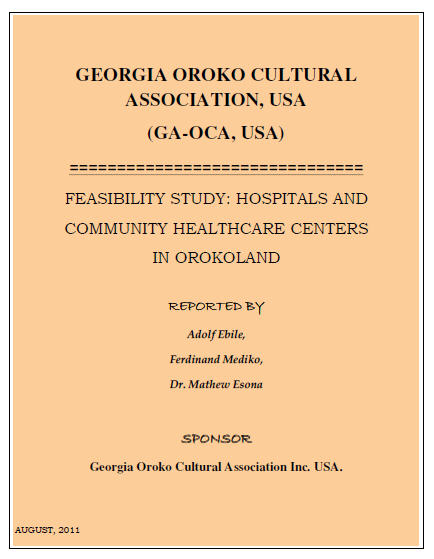
Oroko Georgia Sponsors Feasiblity Studies on Orokoland

Oroko Georgia Sponsors Feasiblity Studies on Orokoland

Oroko Georgia Sponsors Feasiblity Studies on Orokoland.   By Adolf Ebile

The authors of this report wish to express their heartfelt gratitude to the traditional chiefs, traditional council members, government, church and groups officials as well as the people in the different villages for their collaboration with the field team in the course of this study. Special thanks to Wilson Elangwe and Joyce Mote who understood the importance of the study and engulfed all odds (bad roads, trekking long distances, boating on open sea waters, limited finances, etc.) in implementing this study.

Our thanks also go to Rev. Dr. Sam Esale and Jackson Nanje, executive management representatives of the Dikome Balue Development Corporation (DEDICO) in USA for participating in joint planning meetings with Georgia Oroko Cultural Association’s Project Committee and for helping to coordinate activities of DEDICO field volunteers in Cameroon.
Indeed, our sincere thanks go to all members of Georgia Oroko Cultural Association for conceiving this great project and for allocating funds to ensure the study is carried out from start to finish. Thanks to Mr. Ati Adolphus for the pool of information he brought from his private trips to Cameroon. Those information have been included in the document.  

We hope this study serves its purpose. It is also expected that this report will serve as a reference document for policy makers, students, government and non-governmental organizations as well as research institutions in fully understanding the concerns and needs of hospitals and healthcare facilities in the Oroko land.  You ca read more on this project, and get your own copy here.

Leading Oroko-USA In Challenging Times.

Leading Oroko-USA In Challenging Times.

Leading Oroko-USA In Challenging Times

Ba Iya na ba Tata, bana bua ba Oroko,

It is once again a moment of immense honor for me to provide a summary of our Oroko organizational activities you entrusted in my care and where my team and I intend to take the organization to in the years ahead. I cannot fully express my sincere gratitude to you, for having given me the unique opportunity to serve as your National President. Your trust and patience have been an enormous source of strength and encouragement on which I have relied upon to lead our great Oroko family in the United State. I will divide our activities on two fronts: United States and Cameroon.

Activities or accomplishments in the United States in 2018

My administration has only been in existence for a year, but we have scored some major victories despite all that has inflicted our divisions of Meme and Ndian in Cameroon.

  1. My administration took over from Prince Fred Mediko at the Oroko Boston Convention in 2017. The Oroko Cultural Association had previously lost its 501(c)3 or its Federal Non-Profit Status during the presidency of his predecessor however, it only took my administration five (5) years later to reinstate the lost status. Today, I am proud to report to you that OCA-USA is again an accredited non-profit organization with a 501 (C) 3 status under the US tax code. Going forward, all expenses incurred in the service of OCA-USA shall be itemized and deducted from your federal income taxes. It has also opened the window for OCA-USA to raise funds again from individuals, donor organizations and other foundations to finance all its projects.
  2. We are also engaged in growing our organization by opening new chapters throughout the United States. Chicago made us proud in 2018 not only because a new chapter was formed led by Tata Ebenezer Ekoi, but they equally hosted one of the most successful national conventions in the history of our organization. We are hoping that Alabama, California and Iowa shall all be constituted come the 2019 convention in Atlanta.
  3. In line with our tax-exempt status, OCA-USA now has an official seal of authority to serve as an administrative symbol for all OCA-USA administrative documents. This seal will be handed to every subsequent administration upon taking office. To create a synergy with all Oroko sons and daughters, OCA-USA has created a social media portal on WhatsApp which is a platform for ideas and discussions on issues affecting the Oroko nation. Membership is opened to all Oroko sons and daughters.
  4. My administration equally created a Think-Tank group, bringing together past National Presidents and people of measured value, to find solutions to the most difficult problems afflicting the growth of the Oroko people.
  5. In order to succeed in all our undertakings, we have invited the Lord in our daily activities by creating a Prayer line under the reverend leadership of Dr. Charles Misori. The prayer sessions ask of the Lord to be in the presence of the Oroko people and to guide then to be prayerful.
  6. In Boston (2017), the out-going President, Prince Fred Mediko, presented to the General Assembly a plea to help two of our sisters in Atlanta who were battling the dreadful disease of cancer. My administration heeded to the decision of the General Assembly to help the two ladies and generated funds using two different GoFundMes. I am glad to announce that your financial contributions helped one of the ladies to celebrate and rejoice because, with the help of the Almighty, she’s cancer-free. The other lady is equally making a tremendous progress towards recovery. We should continue to be each other’s keeper.

What we have been doing in Cameroon.

While we shall continue to address some of the issues we have in the United States, we felt compelled to start addressing some of the problems in Cameroon as well. The current Anglophone crisis which started in 2016 has hit our people the hardest and, Oroko USA has therefore decided to commit a lot of its resources to bring humanitarian supplies to the Internally Displaced Population.

This past year has been very eventful and therefore needing our intervention. The ongoing violence in our homeland has brought an untold burden to our people who have been hit hardest leaving, a heavy load of humanitarian burden for us to address. And as the threat on our communities remains on the rise, the gaze of our brothers and sisters, caught in this quagmire, remains fixed on us to take action. Whether or not we understand the enormity of the dangers they face, the unbeatable truth remains; we are the last hope of our people as they wallow in what is fast becoming a human catastrophe.

As a family, we have resolved to tackle that which we could with the limited resources we were able to raise in 2018. To alleviate the dehumanizing conditions our people are caught in as a result of the Anglophone Crisis, we dedicated much of the proceeds of our recently-held Oroko National Convention in Chicago to address the humanitarian catastrophe in our Oroko land. I want to personally thank all the Oroko people and non-Oroko people who contributed to this cause. Your contributions remain one of the bravest moves that this union has ever committed to as it has directly contribution to the effective mobilization of funds for our Internally Displaced Population (IDP). Our first phase of the humanitarian effort was concluded with the provision of food and personal care items of several villages and communities across Oroko land, amounting to the sum of $8,000 or (4,640,000FCFA). In partnership with the L.M Nanje Foundation, OCA USA has shipped a $20,000 (11,600,000 FCFA) worth of consignment of medical supplies for our displaced populations. In the days ahead, my team will be providing you with updates on our mission in Oroko land, bringing with them the voices of those you chosen to help. We shall publish our activities on our website, www.orokousa.org

In this regard, I cannot help but continue to solicit your unflinching support to do even more towards redeeming our community from distress. We will continue to stay in solidarity with our people and encourage more charitable contributions. We will not relent! The existence of GoFundMe links and other channels of contribution are there to make this possible for us. This is the moment that our people need us the most. That is why it is my greatest desire that continue this mission in our next National Convention.

My Executive and various stakeholders of our family have recently decided to galvanize and expose the Oroko culture beyond the ambits of its people unanimously voted to bring an Oroko artist of choice to our National Convention which is to be held in Atlanta. If we do not encounter visa problems at the American Embassy, Betondi James, Nwan’a Mboka, will be our guest artist in the Atlanta Convention in 2019.

I want to take this unique opportunity this pristine office has given me to encourage Oroko associations in the diaspora (United Kingdom, Germany, South Korea, Thailand, South Africa, Finland, Ireland and others) to galvanize their activities to showcase the Oroko culture in their respective areas. They should concentrate their efforts to raise funds towards humanitarian contributions now considering the dreadful crisis in our regions. Like we say in our dialect, Itongi basusu isa retaka(many hands do light work)

Finally, on behalf of the OCA National Executive and the great Oroko family in the United States, I offer our deepest condolences to all those who lost loved ones to death during this passing year. We remain united with you in all your moments of grief and are determined to lend you the most support we possibly can. In like manner, we offer our hand of congratulations to all who welcomed new members into their families this year. It is always a thing of great joy for children to be born and meet a world willing to support them in their growth.

On the appointment of the New Prime Minister from Ndian division.

Never in the history of Ndian division and of the Oroko people have we ever been blessed with a very high-profiled appointment as that of Chief Dr. Dion Ngute Joseph from Bongongo I. He was appointed Prime Minister and Head of Government by President Paul Biya on Friday, January 5, 2019.While all of Ndian and the rest of the Oroko people should be grateful for this gift by the Head of State, I urge the Oroko people to rally behind the Prime Minister to ask him the question: How can the Oroko people be of help to him to make his job easy. At the same token we cannot be blind of our expectations of him. Equally, our expectation is for him to put a stamp on development in the Oroko land before he makes his exit on the national political scene.

To members of the Global Oroko Nation, listening or reading my monologue, I say the time is now for us to unite as one family and light the beacon of our land’s development. For ages, we have witnessed the scourge of retardation, not because we do not have the license of growth but because we have sought for it in division. I have been adequately elated by the spirit of Oroko unity that I see from across the continents: in Europe, Asia and the Americas. I look at the enormous work that you all do, especially currently that our community needs you most, and my hope remains resolute. Keep it up!!! For I know that the dawn of Oroko awakening has finally come. There is so much we can accomplish if we work together as one man, one family. I therefore call on you all to think about this and remain determined towards bringing us together for a common purpose, in service to our great Oroko family.

The days ahead will be decisive, and OCA will brave them not by words but by action in unity. The projects we will undertake and how we execute them will be the only measure of our determination to remain stronger than ever and to take the name of Oroko to its deserving heights. And do not be ashamed to call yourself Oroko wherever you are. Because it is such pronouncements that we make ourselves known in world.

Long live OCA, USA
Long Live the Oroko Nation.
Iya Dr. Clementine Ebenye Nanje

The Demise of the Oroko Politician. (Jackson Nanje)

The Demise of the Oroko Politician. (Jackson Nanje)

The current Anglophone crisis has so far been a true test to see if the Oroko (Ndian Division) politicians will fold into their usual docility again or rise in a rare occasion to speak truth to power. 
For close to sixty (60) years since the dawn of Cameroon’s independence in 1960/61 the Oroko politician has never seen himself as a relevant partner in Cameroon’s body politic and conversely, the way Cameroon politics is organized, it has hardly had any need to include the Oroko politician in the national polity. One would think that with the wealth coming out of the Oroko land (45% of Cameroon’s GDP which includes 85-5% of oil and natural gas revenue), it should have given the Oroko man the much-needed leverage to be a viable political player in the nation. But no, the possession of wealth in the division, which is always a difference maker elsewhere in the world, has not made any difference to an Oroko politician or brought economic development to their area of jurisdiction. Before we continue with this essay Nanje School of Creative Thinking should define who is and Oroko man?
For historical and geographical perspectives, let’s give a brief history of the Oroko people and their locations on the map of Cameroon. Shortly after independence, the Oroko people were lumped up in one division called the Kumba Division in the South West Region. However, in 1967, considering how large the division was, President Ahmadou Ahidjo decided to split Kumba division into two. This is how Ndian and Meme divisions came into being. The composition of Ndian division has 129 villages (Oroko people), plus the Barombi people of Abor extraction (11 villages), Isangele, Kumbo Etindi, Idabato, Bamuso, Kumbo Abedimo, and the newly acquired Bakassi Peninsula with villages totaling 146 with an estimated population of more than 500,000 people. There are 88-verified Oroko villages in Meme division (https://orokousa.org/clans-and-villages/), making the Oroko tribe the largest assembly of tribal villages in the country. Despite the portly size of the Oroko population, the Oroko politician is yet to deliver anything major to any of its divisions. The two divisions (Ndian and Meme) are the second and third largest of the six divisions in the South West Region after Manyu division. However, with the inclusion of the Bakassi Peninsula, Ndian division is arguably the largest division in the South West Region, presently. This essay will emphasize more about Ndian division because most of the wealth in the South West Region and Cameroon is from the division.
Ndian division does not only possess 85.5% of Cameroon’s oil and natural gas; but possesses a huge supply of cocoa, coffee, and timber. With the wealth that Ndian possesses one would think that it will present the Ndian politicians a formidable platform to lobby for substantial amount of money coming from proceeds of their resources to bring some vitally-needed economic development for the division. The docility of the current Ndian politicians is hereditary. For the more than twenty Ndian parliamentarians (politicians) who have represented and are still representing the people since the dawn of independence, just Chief Victor Ngomo Obie-CNU (Ijowe), Honorable Nwalipenja Nkwelle Lobe-CNU-CPDM (Lipenja) and Hon. Martin Mokube-CPDM (Bafaka Balue) have been true representatives of the people due to most of their interventions. The rest have been hogwash who were and are still being intimidated by their French-speaking colleagues in parliament, especially the unshakeable Speaker of Cameroon Parliament, Djibril Cavayé.
The current Anglophone crisis has so far been a true test to see if the Oroko (Ndian division) politicians will fold into their usual docility again or rise in a rare occasion to speak truth to power. In a unique occasion where the anglophones in Cameroon are complaining of marginalization by their own French-speaking Cameroon brothers with whom they signed the Foumban Accord to unite as equal partners in the formation of the United Republic of Cameroon in 1972, the Ndian and Oroko politicians have been complete bystanders in this impasse. Even if they become vocal as they are expected to, it would have been for genuine reasons because their French-speaking counterpart have done so much wrong in the dismantling of all known companies that flourished and brought prosperity to the region in the past. Furthermore, the Oroko and Ndian politicians’ silence have been so deafening even as they know that the South West Region has the economic leverage because of the huge contribution they make to the nation’s overall Gross Domestic Product (60%) and 45% of which comes from Ndian division. The absolute lack of economic development activities for more than 50 years in the division should urge our politicians to be vocal participants in this anglophone crisis.
Their unbelievable withdrawal from the struggle has been quite unimagineable and a spectacle to behold because there are no roads, no hospitals, no electricity in the entire division, no communication network like radio, television and internet and no banking facilities. The division is equally infested with substandard schools which have been created without funding with many of its teachers and administrators that were posted to schools in the region refusing to honor the government’s transfer requests and as usual, the Oroko and Ndian politicians are unconcerned about the decaying problem. The division is completely disconnected from Cameroon mainland because of the absence of these amenities and yet, the voters and the only three miserable Ndian parliamentarians continue to vote 100% in favor of the Cameroon People’s Democratic Movement (CPDM) party, oblivious of their demise and for fear of the heavy-handedness from the Speaker. On one side, these Oroko politicians who, in the most part, are myrmidons to the CPDM-led government shall be confronted henceforth by an increasingly angry constituent who elected them into office with the hope that they will deliver for them, but have rather decided to serve the government to their detriment.
The question that has always baffled the investigators of Nanje School of Creative Thinking about politics of Ndian Division is whether the Ndian politicians are to blame for the misgivings of the division or the voters who, after more than 50 years of politicking continue to vote into office same party politicians who cannot deliver for them or do not serve their interest?
These are the politicians who have served the Ndian people in the past.
  • Chief Victor Ngomo Obie -CNU (Ijowe)
  • Hon. Mbile Namaso -CNU (Lipenja Batanga)
  • Hon. Okha Bau -CNU (Lobe Town)
  • Hon. Gabriel Etongo -CNU (Bamuso),
  • Hon. William Ebeku -CPDM (Bisoro Balue)
  • Chief Daniel Basembani Monyongo – CPDM ( Dikome Balue)
  • Hon. Nwalipenja Nkwelle-Lobe -CNU-CPDM
  • Hon. Sylvester Itoe Imbia -CPDM (Dikome Balue)
  • Hon. Ebune Nakeli -CPDM (Mundemba)
  • Hon. Besingi -(UNDP)
  • Hon. Mosaki -CPDM ( Mundemba)
  • Hon. Nobert Nangia Mbile -CPDM (Lipenja Batanga)
  • Hon. Benedict Namongo -CPDM (Bamuso)
  • Hon. Peter Mokube -UNDP (Dikome Balue)
  • Hon. Martin Mokube -CPDM ( Bafaka Balue)
The following three representatives of the people shall be up for re-election in 2020: Honorable Peter Njume who represents the 27 Balue villages, 11 Barombi villages and 15 Balondo Ba Nanga villages; Honorable Daniel Ngalle Etongo who represents only Bamuso district; and Honorable Mary Meboka who represents 36 Ngolo villages, 26 Ngolo Batanga villages, 19 Bima villages, 3 Balondo Ba Diko villages, Kumbo Etindi, Kumbo Abedimo, 3 Bakoko villages and Isangele. The next election must signal the beginning for the newly-informed Ndian voters to start taking a hard look at candidates who intend to run for office whether they are qualified to be good servants of the people. Equally, the people must react against any candidate imposed on them without their approval like it is often the case.
After studying the sphere of influence of each of these three parliamentarians, we have concluded that there is a need for at least four (4) additional Members of Parliament (MP) to be awarded to Ndian Division because the few MPs that we currently have cannot possibly cover the large topography and represent their people effectively especially as the transport network system in the division is extremely deplorable. In addition to the four more MPs, Ndian needs two more Senators not just one as is presently the situation. There should be no reason why Fako, which is one of the smallest divisions in terms of size and population in the South West Region to have three Senators and Ndian just one and the Ndian politicians are happy about this designation. These injustices must be corrected by our docile MPs. Secondly, besides being naïve in expressing the needs of their constituencies in parliament, the large expanse of land has proven to be ungovernable by the expressionless MPs of Ndian Division.
This issue of naivety is one of the problems the Ndian electorate must correct in subsequent elections. Thirdly, there is a need for an enlightened electorate to vote for qualified individuals who are required to know the problems of the division. The quest to elect people because we ‘like them’ should be an issue of the past. Qualifications and not love should be the crowning jewel of an educated Ndian voter. Finally, the voters and the candidates for MP must come to terms with the realities of the division by drawing a Social Contract, like that drawn by Jean Jacques Rousseau (a French Philosopher) in 1754. This Social Contract must contain the needs of Ndian division which, the MP candidate must sign as a prerequisite to be voted into office. And if 50%-75% of the items on the Social Contract are accomplished he/she shall be retained in office. But if they cannot fulfill a greater majority of the items on the Social Contract we cannot, in no practical terms re-elect them. We cannot continue to elect individuals who do not have the priorities of the Ndian and Oroko people at heart anymore.
In conclusion, it is seemingly untenable for the current crop of Ndian and Oroko politicians to win the trust of the people they were supposed to be serving because, for ten (10) months since the advent of the anglophone crisis none of these elected politicians have expressed their dismay, opposition or dissatisfaction to the current political dispensation in Cameroon much to the mortification of the constituents. Rather, they have been great bedfellows with the administration.
Jackson W. Nanje.